
Federal Poverty Level Chart
The federal poverty level (FPL) is the income yardstick the Health Insurance Marketplace uses to decide who can get a premium tax credit and who also gets extra savings on a Silver plan. Find your household size below, then read across to see where your expected yearly income falls.
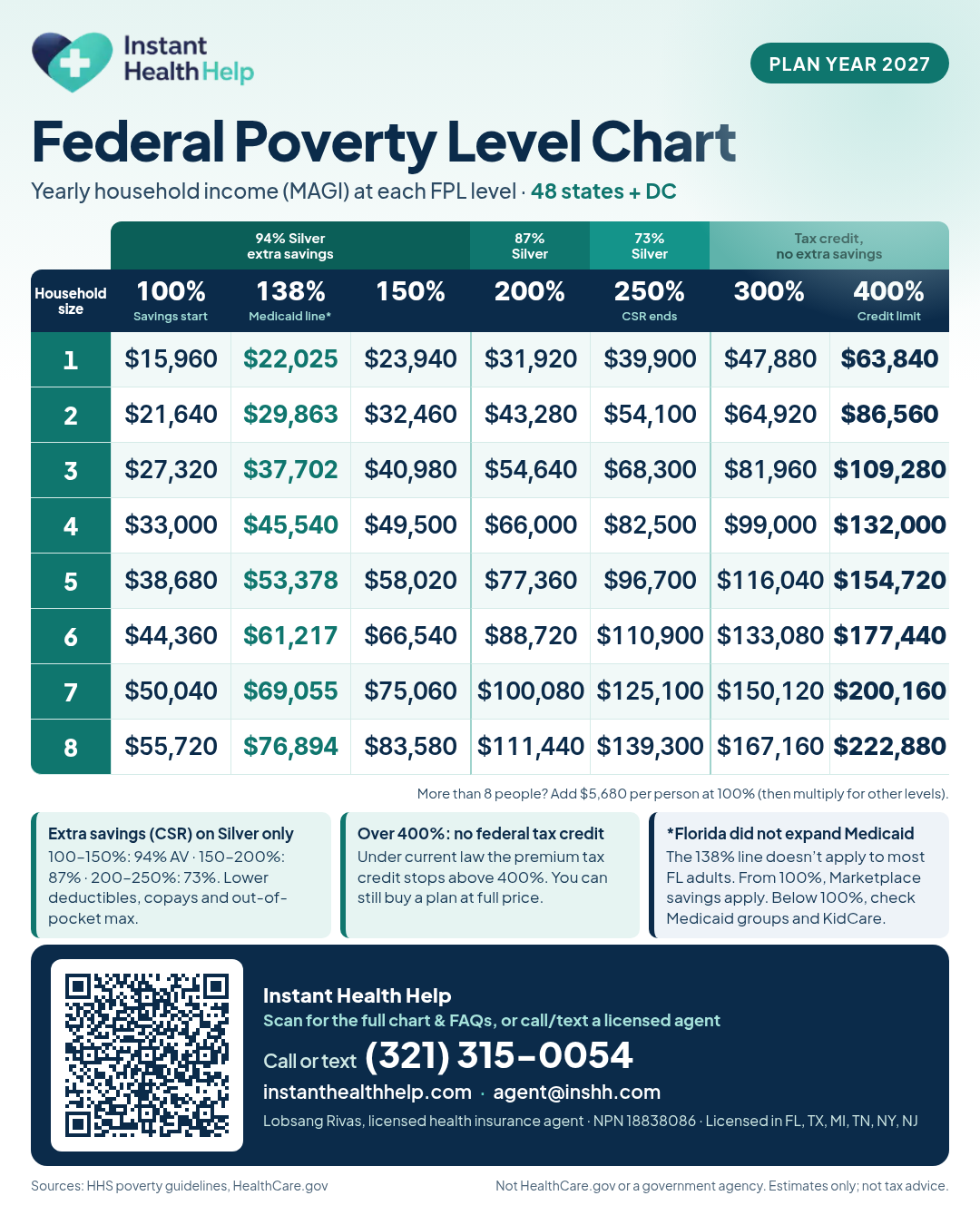
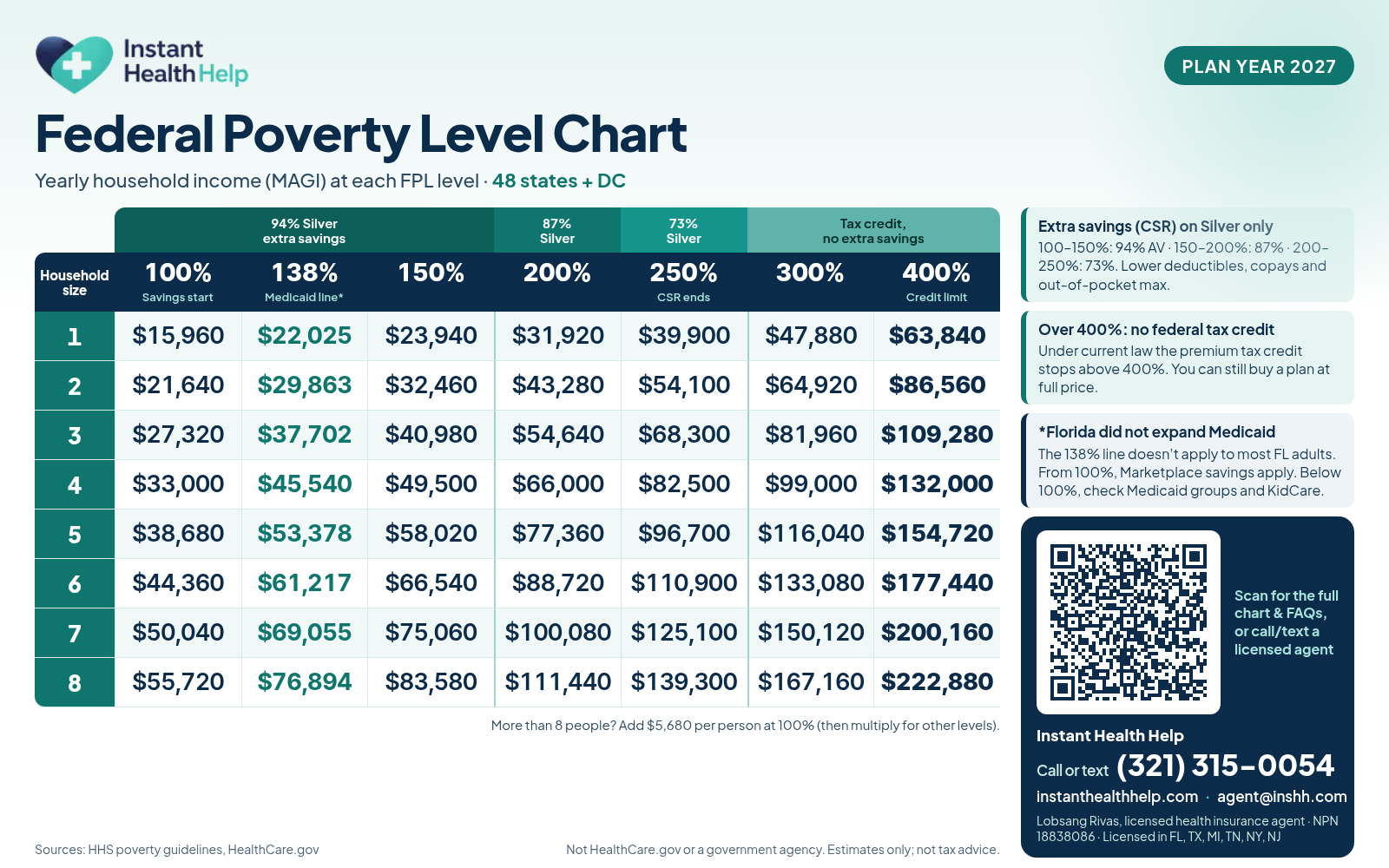
FPL income chart by household size
Yearly household income at each percentage of the federal poverty level, by household size (48 contiguous states and DC). These are the HHS poverty guidelines published in 2026, which HealthCare.gov uses for coverage that starts in 2027. Swipe the table sideways to see every column.
| Household size | 100% | 138% | 150% | 200% | 250% | 300% | 400% |
|---|---|---|---|---|---|---|---|
| 1 | $15,960 | $22,025 | $23,940 | $31,920 | $39,900 | $47,880 | $63,840 |
| 2 | $21,640 | $29,863 | $32,460 | $43,280 | $54,100 | $64,920 | $86,560 |
| 3 | $27,320 | $37,702 | $40,980 | $54,640 | $68,300 | $81,960 | $109,280 |
| 4 | $33,000 | $45,540 | $49,500 | $66,000 | $82,500 | $99,000 | $132,000 |
| 5 | $38,680 | $53,378 | $58,020 | $77,360 | $96,700 | $116,040 | $154,720 |
| 6 | $44,360 | $61,217 | $66,540 | $88,720 | $110,900 | $133,080 | $177,440 |
| 7 | $50,040 | $69,055 | $75,060 | $100,080 | $125,100 | $150,120 | $200,160 |
| 8 | $55,720 | $76,894 | $83,580 | $111,440 | $139,300 | $167,160 | $222,880 |
More than 8 people? Add $5,680 per extra person at 100%, then multiply by the percentage you need (for example, 2 × that amount at 200%). 138% amounts are rounded to the nearest dollar; every other amount is exact. Alaska and Hawaii have higher guidelines, so use the HHS tables for those states.
This chart follows the federal rules HealthCare.gov uses (Florida, Texas, Michigan and Tennessee). New York and New Jersey run their own marketplaces, NY State of Health and Get Covered New Jersey, which can add state programs and savings, so your options there can differ from this chart.
Last reviewed October 2026 against HHS and HealthCare.gov.
How to use this chart
- Count your household. For the Marketplace, that is usually you, your spouse if you are married, and everyone you will claim as a tax dependent, even people who don’t need coverage.
- Estimate your household income for the year you want coverage. Add up the expected income of everyone in the household (see what counts below).
- Find your row and read across. The column your income falls under tells you roughly which savings you could get.
Example: A household of 3 expecting $50,000 is at about 183% FPL. That is above $40,980 (150%) and below $54,640 (200%), so they could get a premium tax credit plus 87% extra savings if they pick a Silver plan.
Who counts in your household
- You and your legally married spouse. In most cases married couples must file taxes jointly to get savings.
- Anyone you will claim as a tax dependent, such as children, a dependent parent or other relatives.
- Not roommates, an unmarried partner you won’t claim, or a non-dependent relative who lives with you.
- If someone else claims you as a dependent, you are part of their household.
What counts as income (MAGI)
The Marketplace uses modified adjusted gross income (MAGI): your adjusted gross income (IRS Form 1040, line 11) plus any untaxed foreign income, non-taxable Social Security and tax-exempt interest. For most people it is the same as, or close to, their AGI.
- Count: wages, tips, net self-employment income, unemployment, all Social Security and SSDI, most retirement and pension withdrawals, investment, rental and capital-gains income.
- Don’t count: SSI, child support, gifts, loan proceeds, veterans’ disability payments, workers’ compensation, Child Tax Credit payments.
Self-employed or paid by the gig? See how to estimate self-employed income. If your income changes after you enroll, report it so your tax credit stays right; otherwise you could owe money back when you file your taxes.
Immigration status matters too. Federal law has narrowed which lawfully present immigrants can get the premium tax credit, starting with coverage in 2027. If anyone in your household isn’t a U.S. citizen, talk with us before relying on this chart.
Extra savings on Silver plans (cost-sharing reductions)
If your income is between 100% and 250% FPL, you can get cost-sharing reductions, also called extra savings. They lower your deductible, copays, coinsurance and out-of-pocket maximum, but only if you pick a Silver plan. Your tax credit works on any metal level; the extra savings don’t.
Silver plan extra savings by income. Dollar ranges use the chart above. Out-of-pocket caps are the federal maximums CMS set for plan year 2027 coverage; many plans are lower.
| Income (% of FPL) | 1 person | Family of 4 | Silver plan pays about | Out-of-pocket cap (self / family) |
|---|---|---|---|---|
| 100% to 150% | $15,960 to $23,940 | $33,000 to $49,500 | 94% | $4,000 / $8,000 |
| Over 150% to 200% | over $23,940 to $31,920 | over $49,500 to $66,000 | 87% | $4,000 / $8,000 |
| Over 200% to 250% | over $31,920 to $39,900 | over $66,000 to $82,500 | 73% | $9,600 / $19,200 |
| Over 250% (no extra savings) | over $39,900 | over $82,500 | 70% (standard Silver) | $12,000 / $24,000 |
“Silver plan pays about” is the plan’s actuarial value: the share of covered costs the plan pays for an average group of members. American Indians and Alaska Natives have additional cost-sharing protections. Read our plain-English guide to cost-sharing reductions and how Bronze, Silver and Gold compare.
The 138% line and Florida Medicaid
In states that expanded Medicaid, most adults with household income below 138% FPL can qualify for Medicaid on income alone. That is why the 138% column is on the chart.
Florida has not expanded Medicaid. The 138% line does not apply to most Florida adults.
100% to 138% FPL in Florida: most adults go to the Marketplace instead, where they can get a premium tax credit and the 94% Silver extra savings.
Below 100% FPL in Florida: most adults without a qualifying situation fall into the coverage gap: too little income for Marketplace tax credits and no Medicaid on income alone. Florida Medicaid can still cover children, pregnant women, parents and caretakers with very low income, people 65 or older, and people with disabilities. Children may also qualify for Florida KidCare.
Apply for Florida Medicaid through DCF MyACCESS (details on the Florida DCF Medicaid page). More in our guide to Florida’s Medicaid coverage gap.
We are not DCF. Instant Health Help is a private, licensed insurance agency, not the Florida Department of Children and Families (DCF), MyACCESS or any government agency. DCF decides Medicaid eligibility. We can walk you through the application and your Marketplace options.
Medicaid and CHIP use the newest poverty guidelines and your current monthly income, so their cutoffs can differ from this Marketplace chart.
The 400% limit on tax credits
Under current federal law, the premium tax credit is available from 100% up to 400% FPL. Above 400% ($63,840 for one person, $132,000 for a family of four on this chart), there is no federal tax credit and you would pay the plan’s full price. The temporary rules that removed this limit have ended, and no extension had passed when we last reviewed this page. Close to the line? Retirement contributions and some other deductions lower your MAGI, so it is worth checking with us. Learn more about how Marketplace tax credits work.
Download the chart
Frequently asked questions
What is the federal poverty level (FPL)?
It is an income measure the U.S. Department of Health and Human Services (HHS) updates each year. The Health Insurance Marketplace uses percentages of it, like 100%, 250% or 400%, to decide who can get a premium tax credit and extra savings on Silver plans. Medicaid and CHIP use it too.
Which year’s income should I use with this chart?
Use your best estimate of your household’s income for the year you want coverage, not last year’s. A good starting point is the adjusted gross income on your most recent tax return, adjusted for raises, job changes or other changes you expect. If your income changes after you enroll, report it so your savings stay accurate. Otherwise you could have to pay money back at tax time.
Who counts in my household?
Usually you, your spouse if you are married, and everyone you will claim as a tax dependent, even if they don’t need coverage. In most cases married couples must file a joint tax return to qualify for savings.
What happens if my income is over 400% of the poverty level?
Under current federal law, households with income above 400% of the poverty level do not qualify for the premium tax credit. You can still buy a Marketplace plan at full price, and we can help you compare options. Congress has debated bringing back larger credits; we will update this page if the law changes.
I live in Florida and my income is below 100% of the poverty level. What can I do?
Florida has not expanded Medicaid, so most adults with income below 100% don’t qualify for Medicaid on income alone, and they are also below the range for Marketplace tax credits. You may still qualify for Florida Medicaid if you are pregnant, a parent or caretaker with very low income, 65 or older, or have a disability, and children may qualify for Medicaid or Florida KidCare. Apply anyway, because a full application can show options a chart can’t. Community health centers also offer sliding-scale care.
Does this chart tell me what I will pay each month?
No. The chart shows income ranges, not prices. Your premium depends on where you live, the ages of the people getting coverage, the plan you pick and your exact income. You will see your real price and savings when you apply. Call or text us and we can run the numbers with you.
Not sure where you land? Ask a licensed agent.
We’ll check your household and income with you and show the plans and savings you qualify for. Free to you, in English or Spanish.
Or email agent@inshh.com. Getting ready for enrollment? See Florida Open Enrollment help.
Related guides
- Marketplace cost-sharing reductions in Florida (Silver plan help)
- How Marketplace tax credits work in Florida
- Bronze vs Silver vs Gold plans in Florida
- Florida’s Medicaid coverage gap
- Florida Open Enrollment help
- Estimating self-employed income for Marketplace savings
Sources
- HealthCare.gov: Federal poverty level (FPL) glossary
- HealthCare.gov: Income levels & savings
- HealthCare.gov: Cost-sharing reductions (extra savings on Silver plans)
- HealthCare.gov: What to include as income
- HealthCare.gov: Who to include in your household
- HealthCare.gov: Medicaid expansion & what it means for you
- HHS ASPE: Poverty guidelines
- HHS: Annual update of the poverty guidelines (Federal Register notice, PDF)
- CMS: Cost-sharing limits and reduced limits for Silver plan variations, next benefit year (PDF)
- Florida DCF: Medicaid
- Florida DCF: MyACCESS (apply for Medicaid)
- Florida KidCare
- IRS: Premium tax credit eligibility changes (news release)
Instant Health Help is a licensed health insurance agency. Agent: Lobsang Rivas, licensed health insurance agent, NPN 18838086 (Florida resident license; non-resident licenses in TX, MI, TN, NY and NJ). We are not HealthCare.gov, the Health Insurance Marketplace®, the IRS, the Florida Department of Children and Families (DCF) or any government agency. This chart is for estimates only; your actual eligibility and savings are set when you apply. This page is general information, not tax or legal advice; premium tax credits are reconciled on your federal tax return, so ask a tax professional about your situation. Health Insurance Marketplace® is a registered trademark of the U.S. Department of Health and Human Services. (321) 315-0054 · agent@inshh.com